01
Packaging brief
A useful brief describes decisions and constraints, not preferred styles alone.
- What is changing in the business and why now?
- Who buys, uses, recommends and rejects the product?
- Where will the pack be compared: shelf, marketplace, pharmacy, restaurant or direct-to-consumer?
- Which information is mandatory, which is a claim and which is a marketing priority?
- How many SKUs, formats, languages and launch phases are involved?
- What is fixed by suppliers, regulation, budget or previous recognition?
- Who gives consolidated approval and when are decisions needed?
02
Range architecture
Range architecture is the grammar that lets many products feel related while remaining easy to compare.
- Define what remains fixed across the family: brand position, logo behaviour, typographic rhythm, structural device and information order.
- Define what changes: category, recipe, flavour, strength, audience, benefit, size or market.
- Assign visual codes only where they solve a navigation problem. Too many simultaneous codes create a puzzle.
- Test the system on difficult products, not only the shortest and most attractive SKU.
- Document rules and exceptions so future adaptations do not slowly erode recognition.
03
Print preparation
Print-ready is not a visual adjective. It means the approved design has been rebuilt and checked for a known production specification.
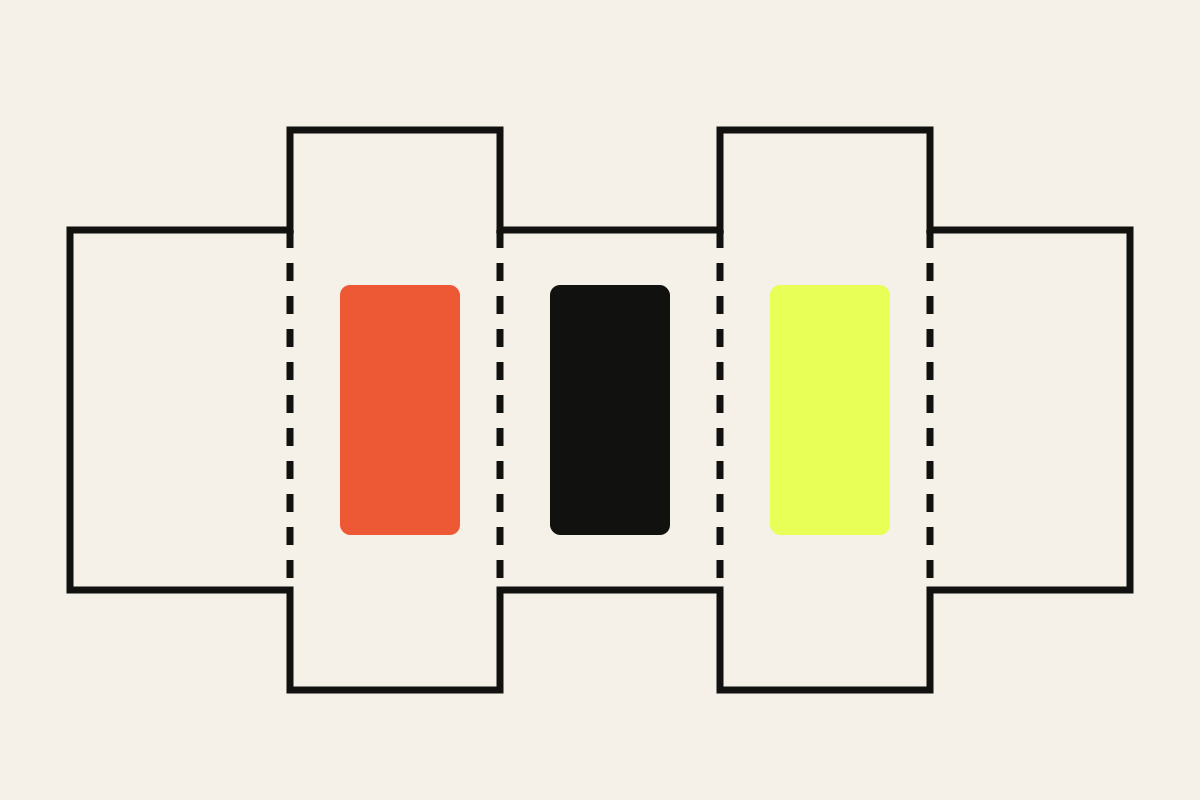
- Obtain a supplier-approved dieline and technical specification.
- Confirm dimensions, bleed, safety, folds, seams, seals, windows and no-print zones.
- Use the required colour mode and verify spot-colour, white-ink, varnish and overprint instructions.
- Check linked images, effective resolution, fonts, barcodes and minimum line or type sizes.
- Separate artwork and technical layers clearly.
- Review a rendered PDF, printer proof and physical sample where appropriate.
- Archive the approved master and record the exact version released.
04
Redesign signals
- The pack no longer supports the price or audience.
- Range additions have destroyed hierarchy and coding.
- Customers or retailers misunderstand product differences.
- The physical pack and e-commerce image tell different stories.
- A new market, language or mandatory-information requirement cannot fit cleanly.
- Competitors have converged on the same visual codes.
- Production changes expose technical weaknesses in old artwork.
05
3D visualization
- Use early 3D to compare proportion, label placement, colour blocking and range behaviour.
- State whether an image is conceptual or intended to approximate final production.
- Provide exact dimensions and material references when accuracy matters.
- Approve camera and lighting with low-resolution previews before final output.
- Create a shot list based on real channel needs: hero, group, detail, transparent background, mobile crop and retailer deck.
- Validate physical finishes with supplier samples; a render is not a print proof.
06
EU packaging context
Regulation (EU) 2025/40 on packaging and packaging waste applies from 12 August 2026, with specific provisions and transition dates. Its practical effect depends on packaging type, role in the supply chain and later implementing rules. Design teams should coordinate with qualified legal, sustainability and supplier specialists rather than using a generic “PPWR compliant” badge.
Food, cosmetics and animal feed also have category-specific information rules. Use current official sources and qualified advice for the markets where the product is sold.